| If you’re serious about adding lean mass, peptides offer a targeted alternative to traditional compounds — and the research is catching up fast. This guide breaks down the top muscle-building peptides, how they work, and what to realistically expect from each. |
| What’s Covered: |
| Which peptides are most studied for lean mass supportHow GH secretagogues like CJC-1295 and Ipamorelin compareThe role of IGF-1 in muscle protein synthesisStacking considerations for experienced usersDosage ranges and typical cycle lengths |
If you’ve been lifting seriously for any amount of time, you’ve probably come across the word “peptides” more than once. And lately, the conversation has moved way beyond GHRP-6 in the locker room. Researchers, coaches, and biohackers are paying close attention to a handful of specific compounds that have demonstrated genuine promise for muscle development, recovery, and body composition.
But here’s the thing: the peptide space is noisy. There’s a lot of hype, a lot of questionable claims, and not nearly enough honest discussion about what these compounds actually do and how they do it. This guide cuts through that.
We’re covering the five best peptides for muscle growth, how each one works, where the evidence stands, and how to think about stacking them. No cheerleading, just the science.
Key Takeaways
- Hexarelin has ignited growth hormone release and paved the way for unparalleled muscle development. 💪
- BPC-157 not only accelerates recovery but also acts as a catalyst for muscle repair and growth. 🚀
- IGF-1, a potent peptide mimicking insulin-like growth factors, laying the foundation for substantial muscle growth. 🌱
- GHRP-6 elevates endurance levels for more extended and intense workouts. 🏋️♂️
- Melanotan II, originally known for its tanning properties, holds untapped potential for muscle enthusiasts. ☀️
Muscle Growth Peptide Comparison
| Features | TB 500 | Sermorelin | Hexarelin | Follistatin | CJC-1295 |
|---|---|---|---|---|---|
| 💪 Muscle Strength | ✅ | ✅✅ | ✅ | ✅✅✅ | ✅✅ |
| 🩸 Wound Healing | ✅✅ | ✅✅ | 🚫 | ✅ | ✅ |
| 🏃♂️ Endurance | ⬆️⬆️ | ⬆️⬆️ | ⬆️ | ⬆️⬆️ | ⬆️ |
| 💉 Bodybuilding Dosage | 1-8 mg/Week | 200-300 mcg/Day | 200-300 mcg/Day | 50-100 mcg/Day | 300 mcg/Day |
| 💉 Injectable | Yes | Yes | Yes | Yes | Yes |
| 🔄 Cycle length | 4 Weeks | 4 Weeks | 12-16 Weeks | 10 to 30 Days | 12-16 Weeks |
| 💦 Fat Loss | 🚫 | ✅ | ✅✅ | 🚫 | ✅ |
| 🧠 Cognitive Function | ✅ | ✅ | 🚫 | 🚫 | ✅ |
| 🫀 Cardiovascular health | ✅ | ✅ | ✅✅ | Probably | ✅ |
| 🩺 Side Effects | Mild | Mild to Severe | Slightly Severe | Severe | Very Mild |
| 🧬 Increased Protein Synthesis | ✅ | ✅✅ | ✅ | ✅✅✅ | ✅✅ |
| 🥛 Calcium Retention | 🚫 | 🚫 | 🚫 | 🚫 | ✅ |
TB-500
TB-500 is a synthetic peptide fragment of Thymosin Beta-4, a naturally occurring protein found in almost all human and animal cells. It plays a key role in cell migration, blood vessel formation, and tissue regeneration, making it a valuable compound for recovery-focused research.
Unlike anabolic agents that stimulate muscle growth through hormonal pathways, TB-500 works on a cellular level by improving healing speed, flexibility, and recovery from soft tissue injuries. Researchers often explore its effects on muscle repair, inflammation reduction, and cardiovascular protection.
This peptide is widely recognized for promoting faster wound healing, increased endurance recovery, and enhanced circulation to damaged areas. Its ability to regulate actin, a critical component of cell structure and movement, makes it uniquely suited for studies involving injury recovery and tissue remodeling.
TB-500 is often studied alongside BPC-157 for synergistic regenerative effects, with both compounds showing complementary benefits for muscle, tendon, and ligament repair. It is typically administered via subcutaneous or intramuscular injection in a research setting.
Disclaimer: This content is for informational purposes only. TB-500 has not been approved for medical use by the FDA or other regulatory agencies. Always consult a qualified professional before handling or researching peptides.
Sermorelin
Sermorelin is a synthetic peptide analog of Growth Hormone-Releasing Hormone (GHRH-1-29) that encourages the pituitary gland to release endogenous growth hormone (GH). Rather than introducing GH directly, it prompts the body to produce it naturally in pulsatile patterns aligned with its physiological rhythms.
What sets Sermorelin apart is its regulatory harmony. It boosts GH while maintaining more natural endocrine balance and minimizing risks of hormone overshoot. This approach helps reduce side effects commonly linked to direct GH therapies.
This peptide is popularly used in research for supporting muscle mass, reducing fat accumulation, improving bone density, and enhancing recovery. Because it stimulates natural GH secretion, it is often favored in protocols aiming for more physiological outcomes.
Sermorelin is frequently stacked with IGF-1, peptides, or receptor modulators to amplify regenerative and recovery effects in research settings. It is usually administered via subcutaneous injection in controlled cycles.
Disclaimer: This content is for informational and research purposes only. Sermorelin is not approved for human or veterinary use by regulatory agencies.
Hexarelin
Hexarelin (Examorelin) is a synthetic growth hormone secretagogue derived from GHRP-6, consisting of six amino acids. It stimulates GH release by binding to growth hormone secretagogue receptors in the pituitary and hypothalamus, triggering a potent hormonal cascade that promotes lean body mass development and improved body composition. It is one of the strongest GH-releasing peptides available in terms of peak GH output, though its tendency toward receptor desensitization with prolonged use means it is typically run in shorter, cyclical protocols. Research has also explored its potential role in metabolic conditions including diabetes, and its effects on cardiovascular and pulmonary health.
Disclaimer: Hexarelin (Examorelin) is a research compound that has not been approved by the FDA, EMA, or any equivalent regulatory body for human therapeutic use. All information presented here is for educational and informational purposes only and does not constitute medical advice, a clinical recommendation, or an endorsement of use.
Follistatin
Meet Follistatin, the unsung hero in the world of bone density enhancement. This powerhouse peptide, with its 323 amino acids and a glycoprotein structure, plays a pivotal role in defying gravity for your bones.
Acting as a myostatin inhibitor, Follistatin kicks the limits off muscle growth, ensuring your skeletal structure becomes a fortress of strength.
Say goodbye to brittle bones as Follistatin steps in, inhibiting activin to maintain optimal hormone levels.
CJC1295
CJC-1295, a peptide analog of growth hormone-releasing hormone (GHRH), comprises 29 amino acids.
It also causes the pulsatile release of growth hormone (GH) from the pituitary gland. CJC-1295-induced growth hormone (GH) release offers a wide array of effects on muscle growth.
It causes the retention of calcium which is important for muscle contraction. It triggers increased protein synthesis required for muscle growth.
CJC-1295 also sets up a balance between muscle mass and fat loss leading to enhanced strength for bodybuilders.
Do Peptides Actually Work For Muscle Growth?
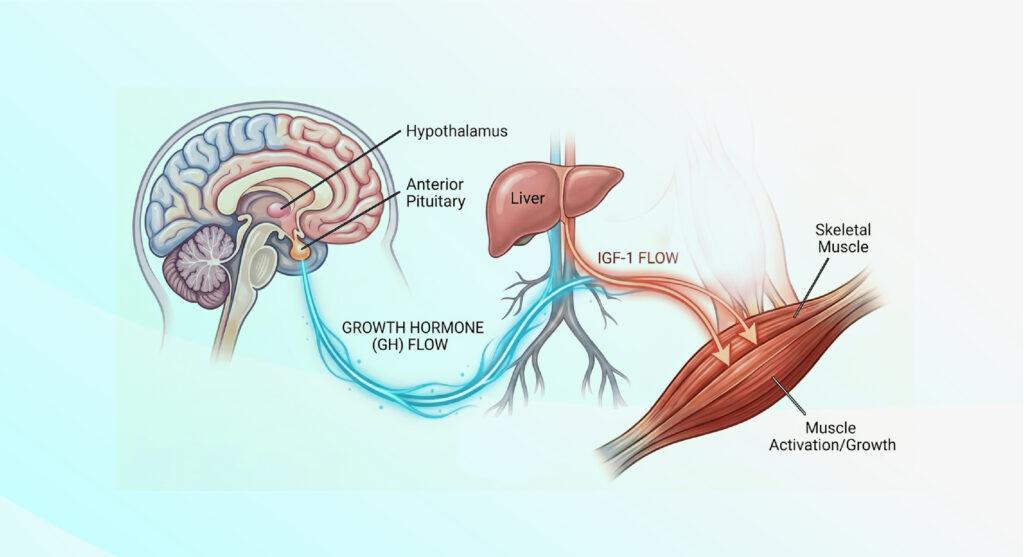
The short answer is yes, but the mechanism matters more than most guides acknowledge, and not all peptides work the same way.
Peptides don’t build muscles by themselves. Your pituitary gland produces growth hormone, and as you age, the signal that tells the gland to keep producing that hormone weakens. GHRH-analog peptides like CJC-1295 and Sermorelin restore that signal, prompting your body to release more of its own GH. Growth hormone then travels to the liver, where it’s converted into IGF-1. This is the compound that actually drives muscle cell growth and repair.
There are four distinct pathways worth understanding before you decide what to run:
The GH axis pathway is the most common route. Peptides like Sermorelin, Hexarelin, and CJC-1295 signal the anterior pituitary to release growth hormone. Some work by stimulating the release signal; others by suppressing somatostatin, which is the hormone whose job is specifically to put the brakes on GH production. Block the brake, and GH stays elevated longer. Most experienced users combine both approaches because they hit the same endpoint from two angles simultaneously.
The IGF-1 route is one step further downstream. GH released into circulation travels to the liver, which responds by producing IGF-1. IGF-1 is what actually drives muscle protein synthesis, which is the direct building of new tissue. This is why GH secretagogues produce their muscle-building effects over weeks rather than days. The pathway has multiple steps and each one takes time.
The actin sensitivity pathway is where TB-500 sits, and it’s mechanistically distinct from everything above. Your muscle fibers contract and relax through the interaction of actin and myosin. TB-500 increases the body’s responsiveness to actin, which accelerates the growth and proliferation of muscle cells directly. No hormonal cascade required. This also explains why TB-500 is so valued for injury recovery; the same mechanism that drives muscle cell growth also drives wound healing and tissue repair.
The myostatin inhibition pathway is Follistatin-344’s territory, and it’s arguably the most aggressive of the four. Myostatin is the body’s built-in limiter on muscle growth. It’s a protein specifically designed to prevent muscle from developing beyond a certain point. Follistatin-344 inhibits myostatin. Remove the limiter, and muscle fiber development can accelerate beyond what the GH axis produces alone. In animal studies the results look promising, but in humans these remain research-only compounds for now.
The reason experienced users stack peptides rather than running a single compound is that these pathways are largely independent of each other. CJC-1295 driving GH release and TB-500 increasing actin sensitivity are doing fundamentally different things to different systems — which is why combining them can produce more than either alone.
If you have any questions regarding any of these products, please feel free to Contact Us. We will be happy to answer any questions you may have.


